
Housing Production Strategy Implementation
Project Overview
In 2025 West Linn adopted a Housing Production Strategy (HPS). It identified 12 actions to address the City’s housing needs. This project builds on that work by taking steps to implement six of those actions. The actions fall into two categories: land use and financial. Staff provided City Council with a project briefing at a July 2026 work session.
7.7.26 City Council Work Session materials and recording
Land Use Actions
Purpose: Reduce potential barriers in local land use regulations to encourage more development of small-dwelling, affordable and workforce housing.
Action 1: Rezone land.
This action consists of rezoning select parcels to increase land capacity for multi-unit housing as well as higher-density single-unit housing in the City. This could mean rezoning some residentially-zoned land to higher-density residential zones, or rezoning non-residentially zoned land to mixed-use zoning allowing multi-unit housing. Note: Rezoning would only be proposed with property owner consent, and would need to go through a typical land use legislation process.
Action 2: Small dwelling development.
This action consists of zoning code updates (such as reduced minimum lot sizes, for example) to encourage more development of small, single-unit detached homes.
Action 9: Zoning for affordable/workforce housing.
This action consists of zoning code updates (such as density or height bonuses, for example) to incentivize affordable and workforce housing.
Process: These actions will proceed through the standard land use legislative adoption process. This includes work sessions and a public hearing with the Planning Commission for a recommendation, followed by work sessions and a public hearing with City Council for a decision on proposed amendments.
Status: Staff is coordinating with consultants to develop a first draft of code updates and potential rezone sites. This follows the direction of a code audit and recommended code revisions as well as rezone site selection criteria, which reflect feedback from a Planning Commission working session held in July 2026. City Council was briefed on these materials in July.
7.15.26 Planning Commission Work Session materials, recording and summary notes
Next Steps: Draft code amendments and potential rezone sites will be presented to Planning Commission at a work session in early 2027. Feedback from that session will be used to refine the materials that will be taken to City Council for adoption later in 2027.
Draft Code Amendments [coming in 2027]
Financial Actions
Purpose: Update local finance policies to lower development, operating and ownership costs to encourage more new housing that is affordable to low- and moderate-income households in West Linn.
Action 3: Update SDCs.
This action involves changing how some system development charges (such as City parks and water fees, fore example) are calculated to lessen the cost to develop new small-unit dwellings and affordable housing.
Action 8: Low income rental housing tax exemptions (aka LIRHTE).
This action involves lowering or waiving some local property taxes for rental housing that is only available to low-income occupants. This lowers the operating costs for affordable rental housing.
Action 11: Homebuyer opportunity limited tax exemption (aka HOLTE).
This action involves lowering or waiving some local property taxes for a limited period for owner-occupied housing that is only available to low-income buyers. This lowers the purchase price of these types of properties.
Process: These actions will not require land use adoption. Staff and the consultant team will facilitate a project working group (consisting of City’s Finance and Public Works Departments, County Assessor staff, affordable housing providers, and home builders) to review proposals before they are brought forward to Council for consideration. Council will also receive regular briefings on the proposals.
Status: The consultant team has developed two memoranda that analyze the tax exemption programs and the City’s SDC methodology and make draft recommendations. The memos reflect feedback following a City Council briefing in July, and Project Working Group meeting #1 in August.
SDC Updates Memo [10.23.26 draft]
Tax Exemptions Memo [8.6.26 draft]
8.13.26 Project Working Group Meeting #1 materials, recording and summary notes
The consultant team also conducted individual stakeholder interviews in September and October 2026. Initial feedback from those interviews was incorporated into a presentation to City Council at a November 3rd work session.
Stakeholder Interview Questions [10.4.26]
Stakeholder Interview summaries [coming soon]
At the November 3rd work session City staff and project consultants received feedback from City Council on the draft recommendations and answered questions to aid in the decision-making process around the financial tools actions.
11.3.26 City Council Work Session materials and recording
Next Steps: The consultant will incorporate feedback from the November 3rd work session and the individual stakeholder interviews into a report with proposed steps to implement the actions. Project working group meeting #2 will be held in early 2027 and the report will be revised based on that feedback. The revised report will be presented at another City Council work session. Council's feedback will be used to finalize the work plan for implementing the financial actions. The adoption process for any policy changes is tentatively scheduled to begin in summer of 2027.
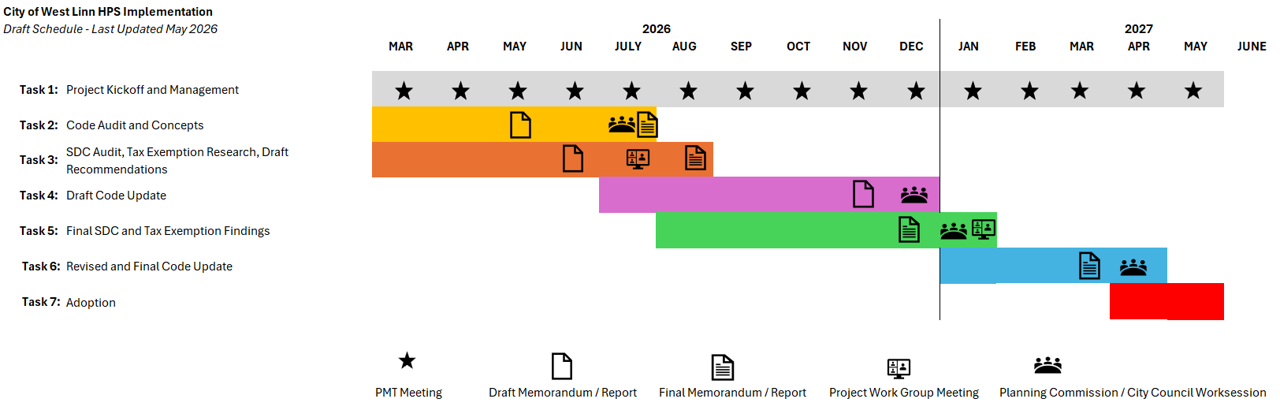
Project Timeline (approximate)
Project Background
HB2003, passed by the Oregon Legislature in 2019 in response to the state’s housing crisis, requires jurisdictions to update their Housing Capacity Analysis (HCA) and develop an associated Housing Production Strategy (HPS). The aim is to help communities meet the housing needs of Oregonians.
After West Linn’s updated Housing Capacity Analysis was adopted in 2023, the Housing Production Strategy was developed and adopted in May 2025. It outlines the tools, actions, and policies for addressing housing needs on a specific timeline. The City is required to demonstrate progress on the HPS actions over the six-year period of 2024 to 2030.
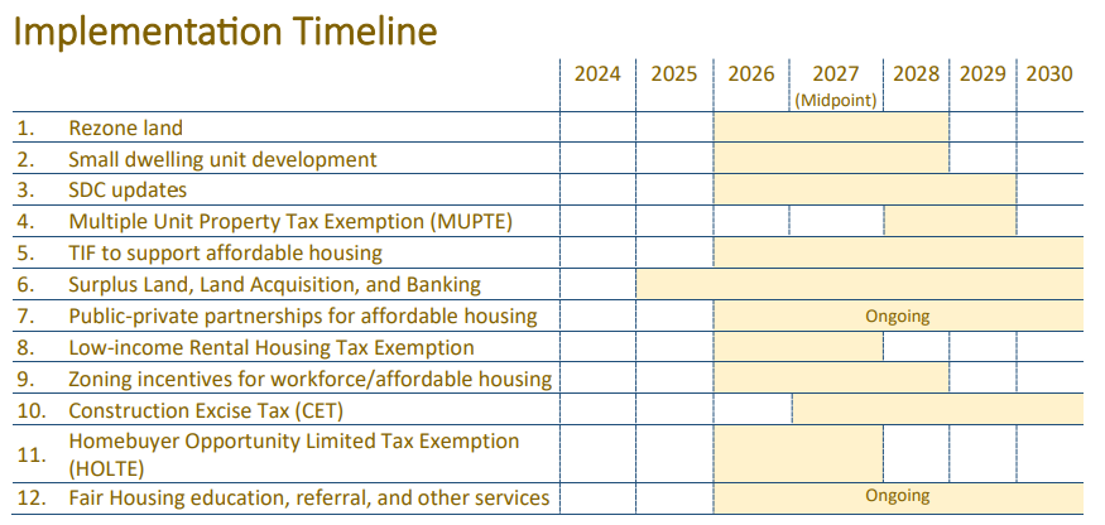
A grant from the Department of Land Development and Conservation (DLCD) is funding the City’s current work, with assistance from consultants MIG and Johnson Economics, to implement six of the HPS actions (actions 1, 2, 3, 8, 9 and 11 in the table above). The full scope of work covered by the grant is detailed in an Intergovernmental Agreement (IGA) between DLCD and the City of West Linn.
HPS Implementation Intergovernmental Agreement (IGA) [updated 9.25.26]
Other Resources
Housing Production Strategy [2025]
Contextualized Housing Needs Assessment [2024]
Housing Capacity Analysis [2021]
-

-

Email dwyss@westlinnoregon.gov
-
The City Council received a briefing from staff on implementation of the Housing Production Strategy on July 7, 2026.
-
 11.3.26 City Council Work Session Materials (1.52 MB) (pdf)
-
Memo - Tax Abatements 10.23.26 draft (391 KB) (pdf)
-
Memo - SDC updates 10.23.26 draft (477 KB) (pdf)
-
Stakeholder Interview Questions 10.4.26 (116 KB) (pdf)
-
Code Audit Memo 7.31.26 (729 KB) (pdf)
-
7.15.26 Planning Commission Work Session Summary (309 KB) (pdf)
-
7.15.26 Planning Commission Work Session Materials (15.4 MB) (pdf)
-
7.13.26 Project Working Group Meeting 1 materials (1.58 MB) (pdf)
-
7.13.26 Project Working Group Meeting 1 Summary (218 KB) (pdf)
-
7.7.26 City Council Work Session materials (687 KB) (pdf)
-
HPS Implementation IGA 9.25.26 (612 KB) (pdf)
-
Housing Production Strategy 2025 (1.58 MB) (pdf)
-
Contextualized Housing Needs Analysis 2024 (712 KB) (pdf)
-
Housing Strategies Report 2021 (667 KB) (pdf)
-
Housing Capacity Analysis 2021 (1.3 MB) (pdf)
-
Buildable Land Inventory 2021 (2.51 MB) (pdf)
