Willamette Riverfront TIF Area Plan
West Linn’s Willamette Riverfront Tax Increment Finance (TIF) Area Plan, adopted in 2023, encompasses approximately 333 acres extending from the Arch Bridge to 16th Street. The TIF District was established to encourage investment in this corridor with the dual purpose of increasing taxable value for all taxing districts and advancing the community’s long-term goals for the area. The Plan anticipates a variety of project types, including transportation improvements, park enhancements, land acquisition and development, and economic development programs or incentives. The Plan allows for roughly 30 years of tax increment collections and authorizes a maximum indebtedness of up to $76.1 million.
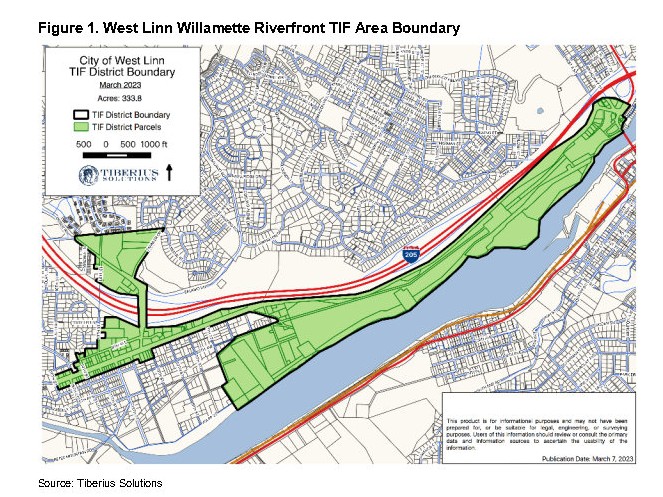
Guiding Principles:
• River Access – Enhance public access to the Willamette River.
• Historic Character – Preserve and celebrate West Linn’s unique history.
• Reinvestment Opportunity – Encourage private investment and redevelopment.
• Transportation Improvements – Improve connectivity and infrastructure within the district.
Plan Administration
Administration of the Willamette Riverfront TIF Area Plan is the responsibility of the West Linn Redevelopment Agency, which is composed of the City Councilors.
Provision for Plan Review and Adjustment
Each year, as the West Linn Redevelopment Agency evaluates projected revenues and potential projects, it may adjust the implementation assumptions outlined in the Report. The Agency may also make changes allowed under the Plan’s Amendments section, provided all adjustments remain within the maximum indebtedness established in the Plan.
The Plan distinguishes between Substantial and Minor Amendments. Substantial Amendments include adding land to the TIF area that exceeds a cumulative one percent of the existing district boundary or increasing the Plan’s maximum indebtedness. All other modifications are treated as Minor Amendments and may be adopted by resolution of the Agency.
Potential Property Acquisition
Staff was recently approached by the owner of the property at 1793 8th Street (approximately 0.50 acres) regarding a possible purchase. The City is currently assessing whether acquisition of this parcel, or other properties within the TIF Area, could support the strategic objectives of the Willamette Riverfront TIF Area Plan.
What is Tax Increment Financing?
Under ORS 457, Oregon cities may use tax increment financing (TIF) to fund improvements in underdeveloped or challenged areas. When a TIF district is created, the increase in property tax revenue generated by rising assessed values—known as tax increment revenue—is used to repay borrowed funds. These funds are invested in infrastructure and redevelopment projects within the district.
By statute, the total amount borrowed must remain within the maximum indebtedness set in the adopted TIF Plan.
Purpose of TIF
TIF aims to stimulate investment in areas facing aging or inadequate infrastructure, limited development readiness, or other barriers to improvement. Typical TIF-funded projects may include upgrades to streets and utilities, construction of public facilities, support for redevelopment or rehabilitation of private properties, site acquisition from willing sellers, and enhancements to parks and public spaces.
TIF does not raise property taxes and does not add cost to West Linn residents’ tax bills. Instead, it dedicates a portion of existing taxes already collected within the district to support infrastructure and redevelopment projects. This reallocation reduces tax revenue flowing to overlapping taxing districts but does not increase taxes for property owners. The West Linn City Council oversees the District to ensure expenditures are appropriate, transparent, and aligned with community goals.
-
 Notice of TIF Meeting on 10.13.26 (155 KB) (pdf)
-
Potential Updates to the Willamette Riverfront TIF Area Plan 07.21.26 Presentation (665 KB) (pdf)
-
Overview of Tax Increment Financing Presentation (8.92 MB) (pdf)
-
ORD 1743 Willamette Riverfront Tax Increment Finance Area Plan (1.95 MB) (pdf)
-
WILLAMETTE RIVERFRONT TAX INCREMENT FINANCE AREA PLAN (4.44 MB) (pdf)
-
Tax Increment Financing (TIF) District Feasibility Study (5.53 MB) (pdf)